
AI Makes Code Faster, and Technical Debt Deeper for Teams
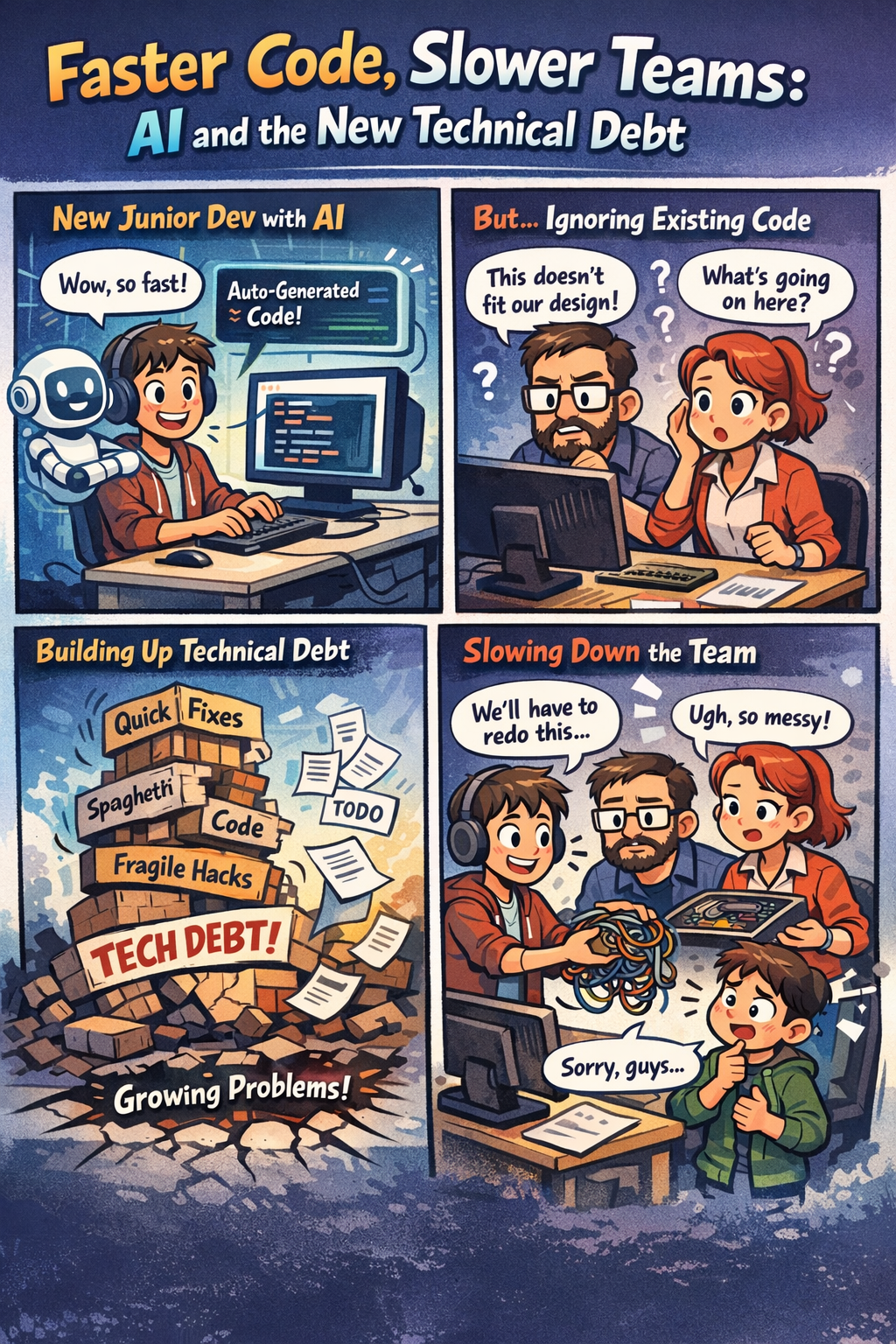
AI has moved beyond simply making development easier.
It is now reshaping organizations, sometimes even driving discussions around headcount reduction.
From my experience, one thing is clear:
doing more work faster is absolutely possible with AI.
Code generation, test scaffolding, refactoring suggestions, AI dramatically increases individual productivity.
However, that doesn’t mean non-developers can fully replace developers through vibe coding alone.
In practice, this remains extremely difficult.
The problem isn’t syntax or tooling.
It’s understanding.
Making partial changes to code without truly understanding it is risky.
And once you move beyond a solo project into a team of two or more people, a new issue emerges:
AI can accelerate the accumulation of technical debt.
AI generates plausible code, but it does not take responsibility for:
- a team’s architectural philosophy
- shared design principles
- long-term maintainability
That responsibility still belongs to humans.
I’ve seen this firsthand.
We once hired a junior developer and worked together on a real production project.
With little prior team or project experience, they focused almost entirely on implementing features—often relying heavily on AI, without deeply reviewing existing code.
Features shipped quickly.
But aligning those changes with our team’s structure, style, and intent required senior developers to spend more time revisiting and rewriting the work.
What looked fast at the individual level became slow at the team level.
In another case, an app built largely by a junior developer using AI looked complete on the surface.
But when requirements changed, modification costs skyrocketed.
The structure lacked shared intent.
The “why” behind the code wasn’t visible.
That’s when it became obvious:
technical debt isn’t just messy code, it’s missing context.
In AI-driven development, this gap can grow faster than ever.
This has changed how I think about hiring junior developers.
Today, I value:
- the ability to absorb team culture
- experience collaborating on shared codebases
- thinking about “the next person” instead of just “the next feature”
more than raw speed or tool proficiency.
If I were hiring again, I wouldn’t ask:
“How good are you at using AI?”
I would ask:
“How well can you work with other humans?”
In an era where AI accelerates code creation,
human judgment, empathy, and collaboration are what prevent teams from slowing down.
The future developer isn’t the one who writes the most code.
It’s the one who helps teams build together, sustainably.