
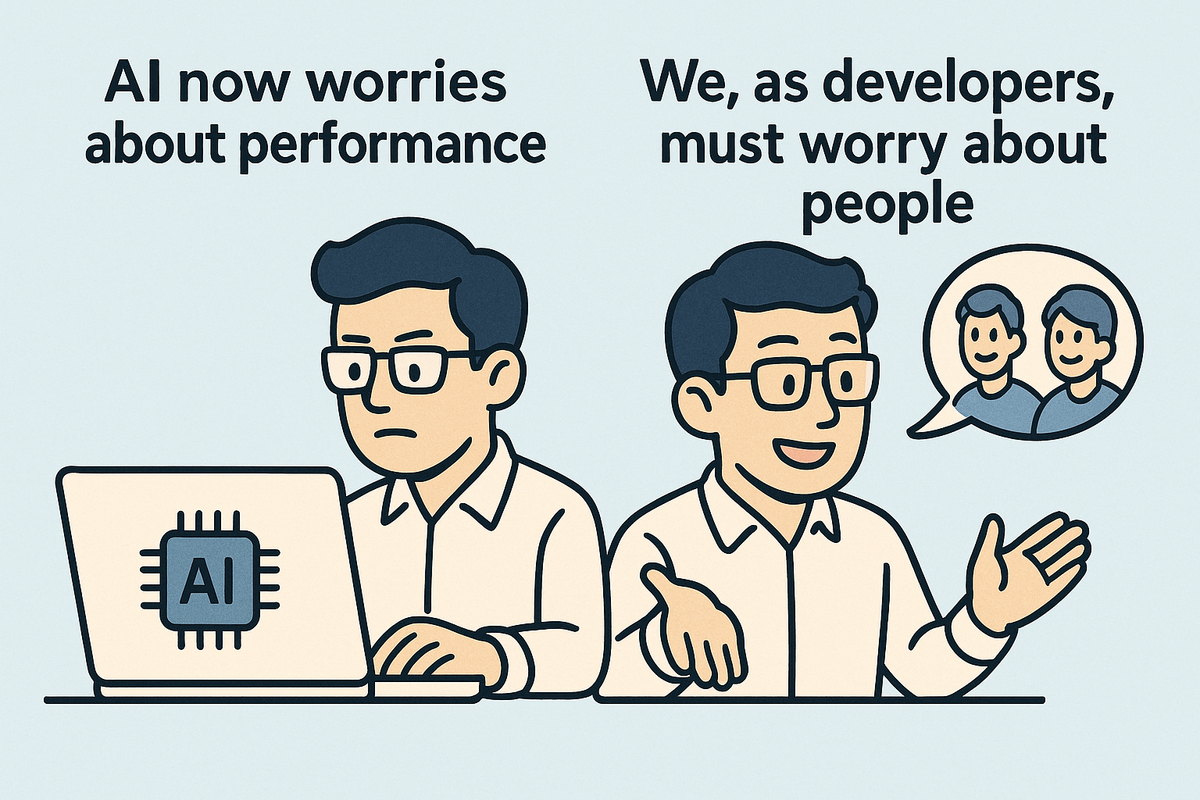
AI now worries about performance. We, as developers, must worry about
When I was deep in hands-on development years ago, I had to understand the inner workings of databases to achieve acceptable performance.
Even a small change in query casing could cause cache aging out, leading to HDD hits and a dramatic drop in speed.
To avoid this, I spent countless hours optimizing query batching and query patterns,
designing DB schemas that reduced disk access,
and fine-tuning indexing strategies.
Back then, this kind of system-level understanding and optimization defined what a “good developer” was.
But things have changed—completely.
Performance can now be solved with a simple cloud scaling decision,
and AI can propose query optimizations or even structural changes to the database.
We no longer need to spend endless nights digging into engine internals just to deliver acceptable performance.
And another shift has emerged.
Questions that once required discussion with teammates
are now often asked directly to AI—
and decisions get made immediately based on those answers.
Convenient, yes.
But the cost is real:
team intent, shared context, and alignment begin to fade.
In the past, even a single feature required meaningful conversations
to ensure the implementation matched the product intent.
Today, with “just build it quickly” as the norm,
many of those critical moments of shared understanding simply disappear.
This is why I now believe:
The more AI handles the mechanical complexity of software,
the more developers must understand human intent and context.
We can build faster than ever before—
but building in the same direction still requires real conversation between people.