
Beyond Cycle Time and Lead Time: What Productivity Really Means in Software Engineering
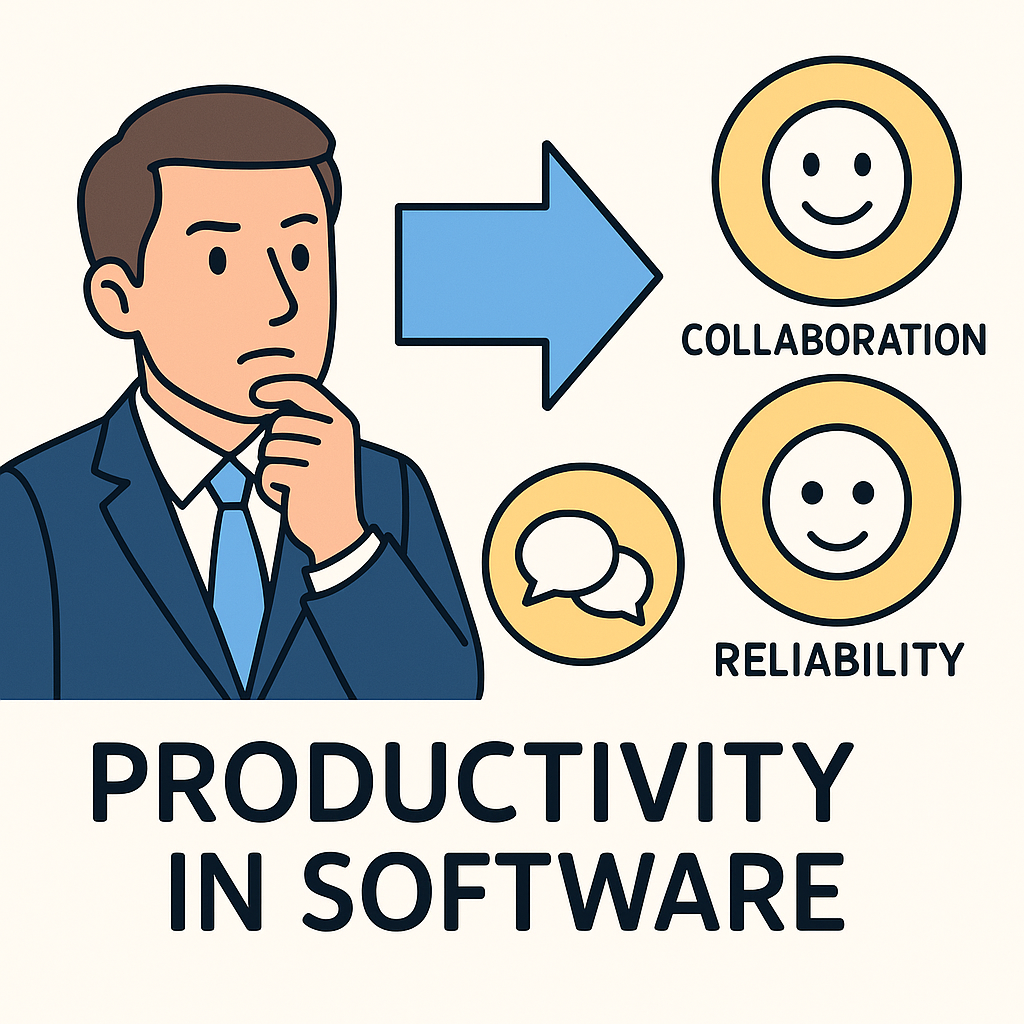
For years, our industry has tried to measure developer productivity in a simple way.
Cycle Time, Lead Time, deployment frequency, sprint velocity—these metrics are useful, but they are far from the whole picture.
And yet, many teams still fall into the trap of managing productivity as if we’re operating a manufacturing line: shorten the cycle, ship faster, repeat. It sounds logical, but it’s an oversimplification of how software actually evolves.
Software isn’t mass-produced. It’s rebuilt every time under different contexts, constraints, dependencies, requirements, and technologies. Real productivity cannot be reduced to a single number.
The Real Signals of Engineering Productivity
A team’s performance is multi-dimensional. So should the metrics be.
Speed
- Cycle Time, Lead Time
- Deployment frequency
Quality & Reliability
- Bug rate
- Change failure rate
- User-reported issues
Customer & Business Impact
- Feature adoption
- Active usage
- Key business KPIs
Developer Experience & Collaboration
- Review time
- Handoffs per change
- WIP limits
- Documentation coverage
- Knowledge sharing
- Burnout / satisfaction indicators
Speed matters, but only when it’s supported by sustainability.
Build the Assets, Not Just the Output
If “we implemented a similar feature faster this time” is the only productivity story, the team isn’t actually getting better. They’re just repeating.
Real capability shows up when the team builds assets that compound over time:
- Reusable modules and APIs
- Shared patterns and architecture
- Standardized development practices
- Documentation and onboarding materials
- Test automation and CI/CD
- A predictable and scalable workflow
These are the engines that scale a team far beyond the next sprint.
This is Why Tools and Processes Matter
Modern engineering excellence doesn’t rely on hero developers.
It relies on a strong workflow:
- Automation
- CI/CD
- Code reviews
- DevOps
- Reduced handoffs
- Logging, observability, and test pipelines
- Continuous refinement of tools and processes
The teams that win aren’t just fast—they are consistently fast without sacrificing quality or maintainability.
Productivity Is Not About the Past—It’s About Adaptability
Relying on past experience to predict future speed is a mistake.
New challenges demand new tools, new skills, and new thinking. Real engineering productivity means:
- the ability to absorb new requirements,
- support new platforms,
- adopt new technologies quickly,
- and maintain reliability while doing it.
The best teams don’t just run faster.
They evolve faster.
The Hidden Problem with “Speed-First Metrics”
Reducing productivity to “Lead Time went down” is the same fallacy as installing more conveyor belts in a factory and assuming output will improve. It ignores the reality of software:
- high uncertainty
- constant change
- invisible technical debt
- UX and maintenance cost
- market impact
- future development constraints
Software is not repeatable manufacturing. Every feature is new context, new domain knowledge, new complexity.
One metric can never describe the completeness of engineering performance.
The Perspective From a Real Team
As we build BCTO and Aline.team, speed alone is never the goal.
We care about:
- reusable architecture and APIs
- developer analytics and insights
- scalable workflows
- global usage and onboarding readiness
- quality and maintainability
- data-driven decision making
This matters more than “finishing a functionality faster”.
Our goal is not to ship quickly once, but to create a system that allows continuous delivery of value across teams, regions, and products.
The Real Definition of Engineering Productivity
True productivity includes:
- speed and shipping velocity
- reliability and stability
- long-term maintainability
- developer experience and culture
- ability to adapt quickly
- customer and business value
- learning, growth, and team capability
A single metric can tell you if the engine is running.
But it cannot tell you if the vehicle is healthy, scalable, or even heading in the right direction.
What Leaders Should Focus On
Stop obsessing over short-term velocity in isolation.
Invest in:
- architecture and reusable assets
- documentation and onboarding
- collaboration and processes
- developer experience and culture
- automation and testing infrastructure
- long-term capability and adaptability
That’s where real productivity compounds.
Final Takeaway
Software productivity isn’t about just moving faster.
It’s about building the right foundation so you can keep moving fast, with quality, over a long time.
We don’t want to just measure speed.
We want to build systems, teams, and products that scale.
That is the real meaning of productivity in modern software engineering.