
Code Quality, Technical Debt, and When to Pay It Down
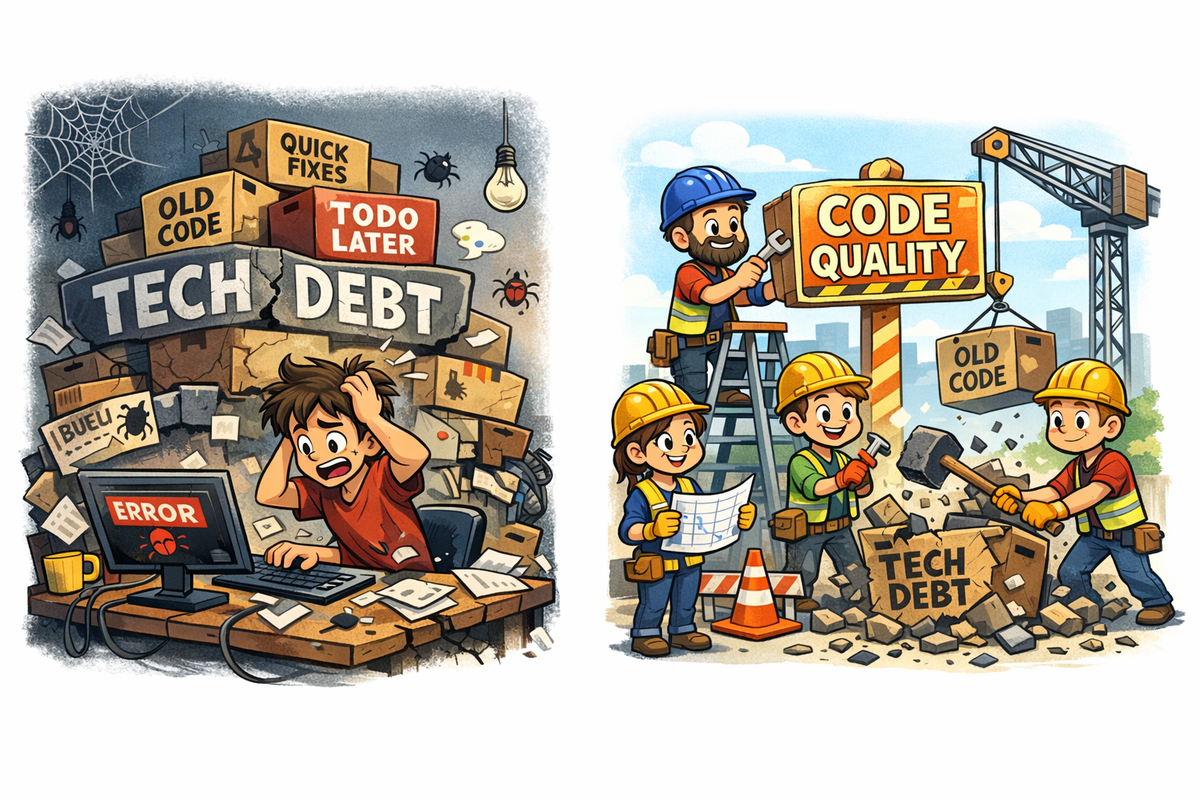
This article follows an earlier post:
https://blog.aline.team/when-code-quality-becomes-a-convenient-explanation/
In that piece, I wrote about how “code quality” is often used as a summary, not a diagnosis.
This article builds on that idea and focuses on a question founders and engineering leaders ask repeatedly.
When is the right time to address technical debt and invest in improving code quality?
Code quality and technical debt are related, but not the same
Code quality describes the current state of a codebase.
Can engineers understand it without tribal knowledge?
Can changes be made with reasonable confidence?
Can the team own and operate it without constant fear?
Technical debt describes future cost.
It is the extra time and effort required later because certain tradeoffs were made earlier.
Sometimes those tradeoffs are intentional.
Sometimes they are simply the cost of moving fast.
Low code quality tends to increase technical debt.
Accumulated technical debt makes improving code quality more expensive.
They reinforce each other.
A simple way to think about it is this.
Code quality is today’s condition.
Technical debt is tomorrow’s bill.
The question teams eventually ask
Once teams recognize this relationship, the next question is predictable.
When should we stop pushing forward and clean things up?
There is no universal answer, but there is a practical way to think about it.
A practical benchmark
One useful benchmark is this.
Could the current product run in production for the next six months with minimal code changes, without putting the business at risk?
If the answer is yes, the team may be in a position to deliberately pay down technical debt and improve code quality.
This is not a technical benchmark.
It is a business one.
If sales, customer support, and operations can move forward without requiring constant engineering changes, the team likely has the space needed to invest in cleanup work.
Why six months is a reasonable reference point
Six months is not a rule.
It is a thinking tool.
Three months is often too short for real constraints to surface.
Twelve months is often too late, when workarounds have hardened into structure.
Six months tends to be the window where teams can realistically ask whether the system supports the business or is actively holding it back.
The number itself matters less than what it represents.
Breathing room.
An important caveat
When using the six month benchmark, one sentence should always come with it.
Six months is not a fixed requirement.
It is a way to evaluate whether the team has enough operational stability to invest in improvement.
Without that clarification, teams end up debating the number instead of the decision.
One more thing that matters
If a team decides to pay down technical debt, they should be able to answer a few basic questions.
What are we changing?
Why now?
Who owns the outcome?
Work that cannot be explained rarely stays clean for long.
Improving code quality is not about making things look better.
It is about protecting future velocity.
Closing thought
Every startup carries technical debt.
That is normal.
The real risk is not having debt.
It is running without knowing when and how it can be paid down.
When teams talk about code quality, the signal is usually already there.
What they need next is not urgency, but a clear decision framework.
That clarity is often the difference between a system that evolves and one that collapses under its own weight.