
The Model T Moment of AI, and the New Responsibility of Developers
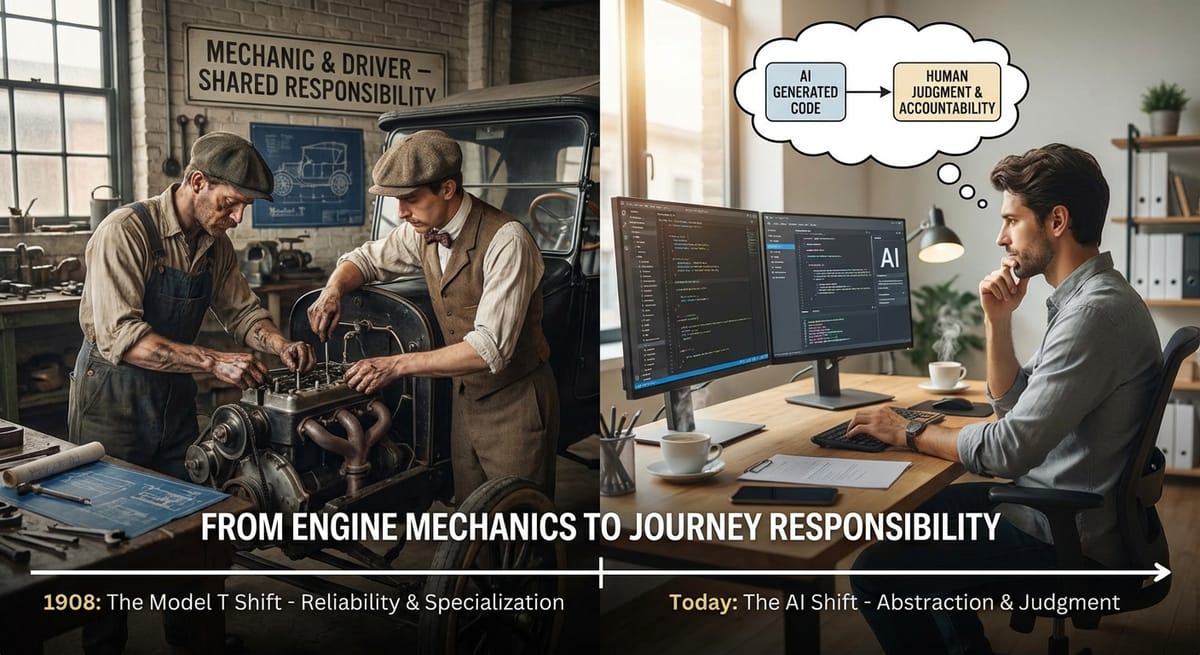
In the early days of automobiles, driving was not a simple act. Cars were unreliable, mechanically demanding machines. While not every driver understood engine design in depth, operating a vehicle required far more technical awareness than it does today.
The real shift began in 1908 with Henry Ford’s Model T and the introduction of the moving assembly line. Standardization and mass production transformed cars from fragile mechanical experiments into accessible consumer products. As reliability increased, the roles of driver and engineer began to separate.
Technology grew more complex internally, yet simpler externally.
What mattered most was no longer “How does the engine work?” but “Where am I going?”
Today, AI-driven software development feels strikingly similar.
For decades, building software required deep knowledge of languages, infrastructure, deployment pipelines, and system architecture. Developers were responsible for implementation at every layer.
Now, AI tools can generate scaffolding, write functional code, connect APIs, and even suggest architecture. The barrier to creating working software is rapidly lowering.
But this shift introduces a new question:
If AI writes the code, who is responsible for it?
History provides a useful pattern. When cars became easier to operate, engineers did not disappear. Instead, their expertise became more specialized and critical. Drivers no longer needed to understand combustion mechanics, but someone still had to design safe engines, ensure reliability, and take responsibility for failure.
Software may be entering a similar phase.
More people will be able to “drive”, to build and ship products with minimal coding knowledge. But reviewing AI-generated output, validating assumptions, ensuring security, and managing system-level trade-offs will become increasingly important.
The developer’s role does not vanish. It shifts.
From writing every line
to designing systems, defining problems,
and taking accountability for AI-assisted outcomes.
AI may reduce the cost of implementation.
It does not reduce the cost of judgment.
In fact, as abstraction increases, responsibility concentrates.
We may be living through another Model T moment,
not because AI replaces developers,
but because it redefines what being a developer means.
Understanding the engine may become optional for many.
Taking responsibility for the journey will not.