
The Number Was Correct, but the Meaning Was Different
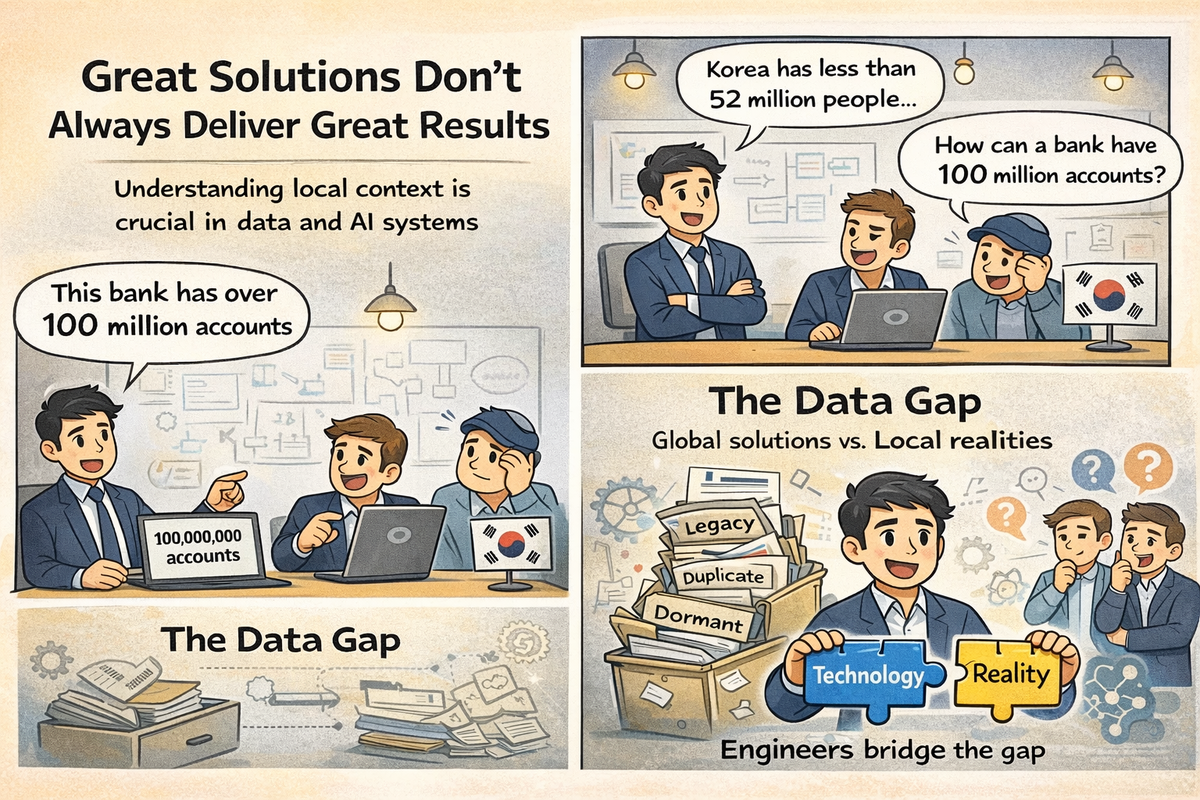
Over many years, the bank had grown through multiple mergers and acquisitions.
As a result, it retained:
- Duplicate accounts
- Dormant accounts
- Legacy system records
- Accounts no longer tied to active customers
Strictly speaking, this was not a clean or healthy account count.
I would not call it a normal metric either.
However, one fact mattered.
The system still had to process more than 100 million account objects.
Without understanding that context, even a high-quality solution would be designed incorrectly from the beginning.
Data Is Never Neutral
That experience fundamentally changed how I think about data and AI systems.
Data looks objective.
Numbers look factual.
But data is never neutral.
It reflects history.
It reflects organizational decisions.
It reflects unresolved trade-offs.
AI systems, in particular, inherit these assumptions without question.
They optimize, detect, and predict based on what exists, not why it exists.
Context is not automatically encoded into data.
No global solution can reliably infer it without local understanding.
Where Global SaaS Often Struggles
This pattern appears repeatedly in global SaaS and AI platforms.
User models designed around US behavior.
Data schemas built for European regulatory histories.
Assumptions that do not survive local realities.
When these systems are deployed globally, the issue is rarely technical.
The failure is usually contextual.
The solution itself is strong, but the environment it is placed into is fundamentally different.
The Changing Role of Engineers in the AI Era
In the past, engineers were evaluated based on:
- Programming languages
- Frameworks
- Architecture patterns
In the AI and data-driven era, the more important questions are changing.
Why does this data exist in this form?
What does this number actually represent?
Where do global assumptions break at the local level?
Is the failure technical, or is it contextual?
AI will continue to accelerate implementation speed.
Understanding the reality beneath the data remains a human responsibility.
Experience Cannot Be Fully Documented
The “100 million accounts” debate could not be resolved through documentation alone.
It required:
- Knowledge of financial history
- Understanding of institutional decisions
- Awareness of accumulated legacy systems
These insights are gained through experience, or through stories from those who have lived it.
Why This Experience Matters More Than Ever
As AI systems become more capable, the value of engineers who understand context, history, and local reality increases.
Great solutions fail when context is ignored.
In the AI era, bridging the gap between technology and reality may be one of the most important skills an engineer can have.