
When Backend and Frontend Live in Different Realities Inside the Same Team
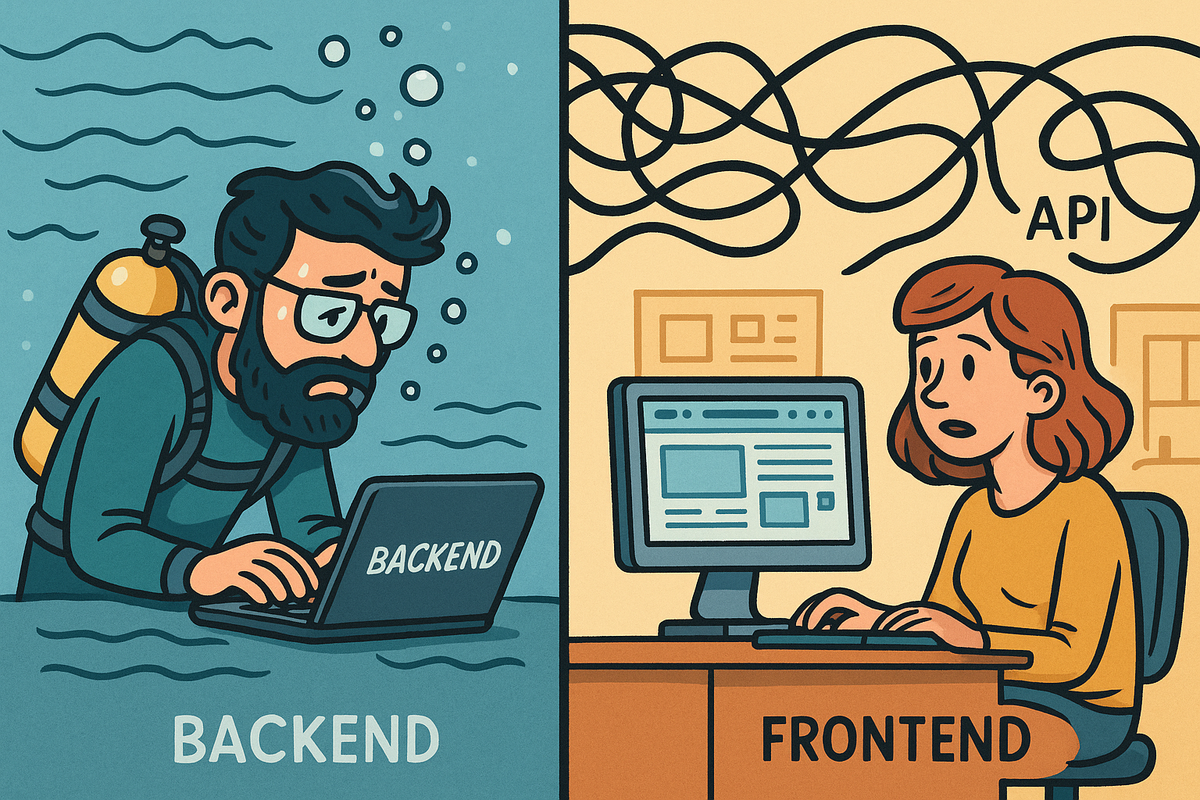
Anyone who has worked in a development or engineering team knows this dynamic: we’re building the same product and sprinting toward the same goals, yet somehow living in completely different realities depending on whether we sit on the backend or the frontend.
Backend Reality: Progress You Can’t See, Pressure You Definitely Feel
A backend engineer can spend an entire day—or week—on something that produces zero visible change.
Refactoring data flows, chasing down race conditions, tweaking indexing strategies, rethinking schema design, eliminating edge-case failure paths…
The work is real, the effort is high, but the output is invisible.
And then standup rolls around and someone asks:
“Still working on that same endpoint?”
“Anything to show?”
The irony?
Backend blockers don’t exist when estimates are made.
They only reveal themselves after the deadline starts slipping.
So backend engineers end up:
- stuck in timelines they never intended
- explaining complexity no one asked about yesterday
- looking like they’re moving slow, even when they’re sprinting underwater
Frontend Reality: Visible Progress, Invisible Dependencies
Frontend engineers ship things that look like progress.
Screens change, UI evolves, buttons appear, interactions come alive.
PMs and design teams love it because it’s tangible.
But here’s what most don’t see:
- the API isn’t ready
- the spec changed
- the flow got redefined
- legal added a requirement
- design updated spacing, again
Frontend timelines are tied to decisions they don’t control.
Yet the questions sound like:
“Why isn’t this page done yet?”
“This is blocking demo—can’t we just finish it?”
Frontend ends up carrying accountability for delays
that weren’t caused by frontend work at all.
And Here’s the Twist
Both sides are working hard.
Both sides care.
Both sides feel misunderstood.
The tension doesn’t come from skill, motivation, or professionalism.
It comes from one root problem:
Work that isn’t visible becomes work that isn’t understood.
When progress isn’t seen:
- backend effort looks like stagnation
- frontend delays look like underperformance
- PMs start guessing
- leadership starts stressing
- morale quietly erodes
This is how teams that like each other
start distrusting each other.
The Fix Isn’t More Meetings
We’ve all been in those teams that respond by adding:
❌ more reporting
❌ more dashboards
❌ more standups
❌ more oversight
But engineering doesn’t get clearer
by adding more interruptions.
The only thing that actually works is:
Making real execution visible in context.
Not vanity metrics.
Not story points.
Not vibes-based velocity.
But answers to questions like:
- What’s actually being worked on?
- How far along is it?
- What’s blocking it?
- Is the delay technical, strategic, or dependent?
- Is the issue at backend, frontend, planning, or scope?
When this becomes visible, everything changes:
Backend doesn’t have to justify complexity.
Frontend doesn’t have to absorb blame for dependencies.
PMs stop guessing.
Leadership stops assuming.
Teams shift from suspicion to alignment.
Speed Is Only Useful When the Team Is Moving Together
Bay Area engineering culture celebrates velocity.
But real teams learn this sooner or later:
Speed that isn’t aligned
doesn’t ship faster — it just breaks trust faster.
When backend and frontend finally see each other’s reality,
delivery stops feeling like a battlefield
and starts feeling like collaboration again.
That’s the environment modern product teams are trying to build —
one where progress is visible, context is shared,
and alignment becomes the default, not the exception.