
When “Code Quality” Becomes a Convenient Explanation
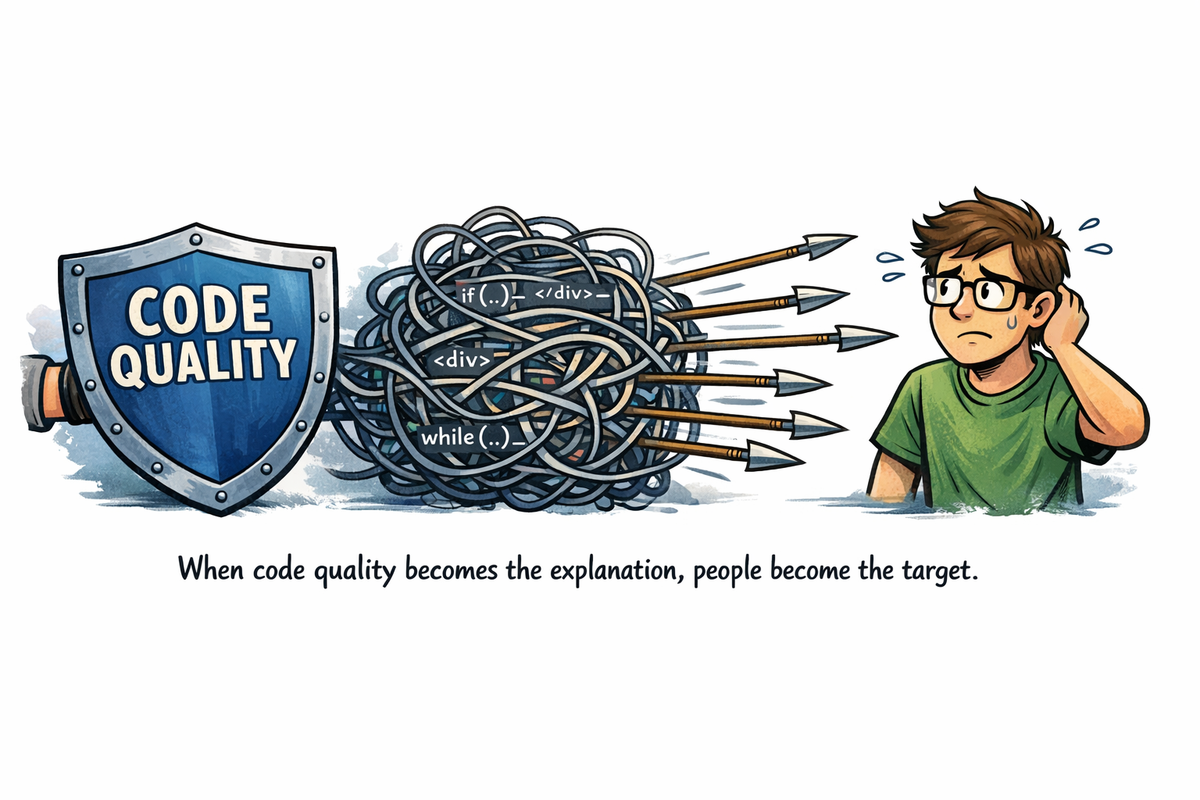
When startup founders come to me to talk about problems in their development teams,
one phrase comes up again and again.
“Code quality is low.”
“That’s why development is slow.”
“Maintenance is nearly impossible.”
“We can’t add new features anymore.”
At first, I assumed this language came from developer friends or advisors.
But after seeing the same situation repeat across many startups, something felt off.
Why would founders of very small teams consistently frame their problems in such a technical term?
A pattern I kept seeing
The situation was often similar:
- An MVP built by an external agency
- A junior developer hired to operate and extend it
- Difficulty understanding structure and intent
- And eventually, this conclusion:
“The code quality is so poor that a senior developer needs to redesign everything from scratch.”
On the surface, this sounds reasonable.
In practice, it often points to a different issue.
“Code quality” as a defensive abstraction
For junior developers inheriting outsourced code, the challenge is real.
They face:
- Missing context
- Unclear architectural decisions
- Fear of breaking things they don’t fully understand
- Responsibility without authorship
Saying “I need more time to understand this system” is hard.
Saying “the code quality is low” is safer.
Not because anyone is dishonest, but because the phrase shifts the problem away from people and toward an object.
Where the arrows end up pointing
Once that explanation reaches the founder, the interpretation often becomes:
- This team isn’t capable
- We need a senior developer
- The current work was fundamentally wrong
At that point, the discussion quietly moves
from structure and process
to people and blame.
And the arrows almost always land on the same developers.
Why I often give unexpected advice
When I hear “code quality” in these conversations, I often say this instead:
“Before hiring a senior developer,
it may be better to give the current team time
to move forward with the existing code.”
This isn’t about defending bad code.
It’s about recognizing that the real bottleneck is often:
- Lack of shared understanding
- Missing decision history
- No proper handover
- And unrealistic expectations in a small team
Code quality is a result, not a root cause
In early-stage startups especially,
code quality reflects accumulated trade-offs:
- Time pressure
- Incomplete alignment
- Decisions made without documentation
- And teams changing faster than systems
When all of that is compressed into a single phrase,
discussion stops, and responsibility shifts.
Closing thought
This isn’t an argument against senior developers,
or a defense of poorly written code.
It’s a reminder that when we say “code quality,”
we should pause and ask:
Are we really talking about code?
Or are we talking about everything around it that was never made explicit?