
When Planning Becomes the Product
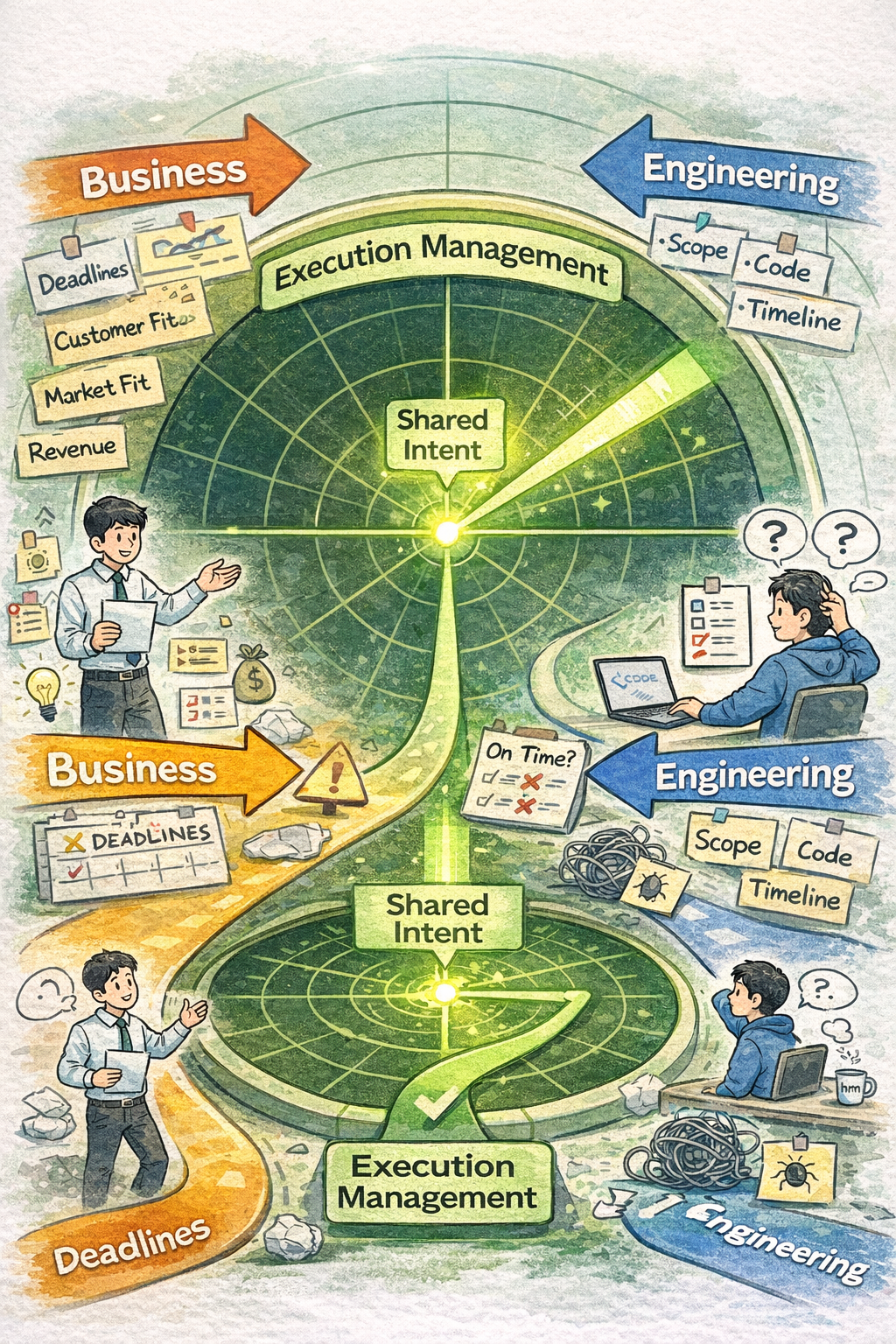
Why execution management matters more than perfect schedules in startups
When I was leading engineering teams at early-stage startups, I noticed a pattern that repeats everywhere.
Planning becomes the job.
The business team sets a deadline.
Engineering translates it into a plan.
Then the team wakes up every day trying to “stay on schedule.”
That sounds reasonable. Deadlines are real. Cash is limited. Stakeholders are waiting.
But after a few cycles, something subtle happens.
The team stops building the product and starts defending the plan.
You can see it in the artifacts:
- A document explaining why the schedule slipped
- A retro that turns into a risk justification report
- A re-plan that promises we’ll “catch up next week”
Eventually the output looks like this:
We shipped on time, but no one wanted what we shipped.
That’s a brutal outcome, and it’s more common than most teams admit.
The real issue isn’t planning. It’s missing intent.
Planning is necessary. But planning is not execution.
Most problems that matter in engineering do not show up in the plan.
They show up when you touch the system:
- Unexpected dependencies
- Legacy code constraints
- Integration complexity
- Slow decision-making across teams
- Misunderstood requirements
None of that looks scary in a spreadsheet.
It becomes obvious only once you start building.
Now here’s the bigger issue.
As the deadline approaches, the team’s attention shifts from product to schedule.
Not because people don’t care, but because the system rewards schedule protection.
And when the schedule becomes the primary objective, engineering and business drift apart.
Business is trying to deliver outcomes.
Engineering is trying to hit dates.
Both are doing their jobs.
But they are no longer playing the same game.
This is how mistrust starts:
- “Engineering doesn’t understand the business.”
- “Business has no idea how complex this is.”
- “They keep changing requirements.”
- “They never ship what we actually need.”
In reality, everyone is reacting rationally to a broken operating model.
What’s missing is shared intent.
Engineering cannot “figure out the market” alone
One mistake I see in startup culture is pushing market responsibility down to engineering.
Let’s be honest.
Engineering teams cannot be expected to:
- interpret the market perfectly,
- define the product strategy,
- choose the right customer outcomes,
- and still execute at high speed.
If you put that burden on engineering, you usually get one of two outcomes:
- engineering overrides product decisions and conflicts escalate, or
- engineering stops thinking and becomes a delivery factory
Neither is healthy.
The real goal is different:
Engineering should deeply understand business intent and implement it in the best possible way.
Business owns the market.
Engineering owns execution.
Intent is what keeps them aligned.
Execution management: 5 shifts that change everything
This is what actually fixed the problem for teams I’ve worked with.
Not better plans.
Better execution management.
1) Treat the plan as a hypothesis, not a contract
Most teams treat the plan as a binding agreement.
But in startups, plans are guesses with nice formatting.
Execution exists to validate or invalidate the guess.
If you treat the guess as the truth, teams will start making distorted decisions just to protect it.
What to do:
- Separate fixed milestones from adjustable scope
- Protect the milestone, flex the implementation
2) Define sprint goals by business intent, not feature output
Feature checklists create the wrong incentives.
They encourage teams to ship functionality even when the intent is missed.
Intent goals look different:
- “Reduce signup friction”
- “Enable the first successful workflow”
- “Make payment completion reliable”
Now engineering can make good tradeoffs without feeling like they are “missing scope.”
What to do:
- Write sprint goals in one sentence as an outcome, not as a feature
- Include a success signal (data, user behavior, measurable event)
3) Surface risk through action within 48 hours
Risk does not show up in meetings.
It shows up in code and real experiments.
If something is “uncertain,” treat that as a red flag and attack it immediately.
48-hour rule:
If a task feels risky or unclear, validate the risk with an executable probe within 48 hours.
Examples:
- API integration risk: implement the minimal auth and call
- performance risk: benchmark with realistic data
- UX uncertainty: prototype and test with users
4) Manage blockers and decisions, not percent complete
Percent complete is a comfort metric.
It often hides the hardest work in the last 20 percent.
Execution management asks different questions:
- what is blocked right now?
- what decision is required?
- who owns that decision today?
What to do:
- run a daily 10-minute sync on blockers
- each blocker must have a decision owner and deadline
5) Never protect schedule by destroying intent
This is the most important rule.
If you hit the date by cutting away intent,
you shipped the wrong thing faster.
In startups, the worst outcome is not “late.”
The worst outcome is “on time and irrelevant.”
What to do:
When the schedule breaks, use this order:
- reduce scope while preserving intent
- simplify implementation while preserving intent
- ship
- move the date only if necessary
Final thought: schedule doesn’t align teams. intent does.
Deadlines matter. Of course they do.
But deadlines are not what makes business and engineering a single team.
Shared intent does.
If you run a startup where planning is the product, people will defend plans.
If you run a startup where execution reveals truth, people will build.
Plans start the work.
Execution decides the product.
And in startups, that’s everything.