
When Product Teams Agree But Build Different Things
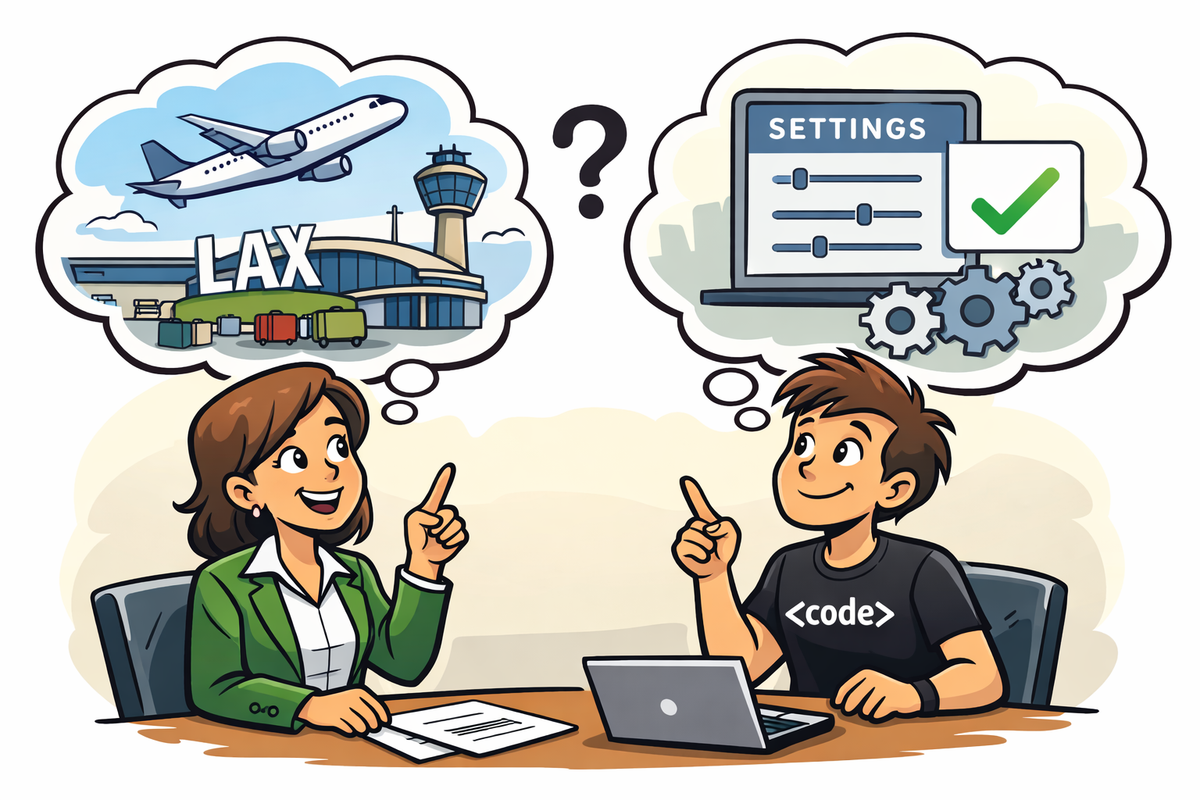
We Agreed on the Destination, But Not on What “Arrival” Meant
After more than 20 years as a developer, engineering manager, and CTO,
I’ve learned that product failures rarely come from poor execution.
They come from something far subtler:
agreeing on the same words while imagining different endings.
“Let’s Go to LAX” , and the Hidden Assumptions
In product meetings, decisions often sound simple.
“Users should be able to configure this themselves.”
Everyone nods.
The discussion moves on.
But in reality, each person is imagining a different kind of arrival.
It’s like saying:
“Let’s go to LAX.”
- One person is thinking:
“I just need to get there to catch a flight.”
(The airport is a means to an end.) - Another imagines:
“Arriving at the airport terminal itself.”
(Clear signage, access, structure.) - Someone else is thinking:
“Finishing the business trip that happens after landing.”
(The outcome that the journey enables.)
Same destination name.
Completely different definitions of success.
Developers Optimize for Completion, Not Meaning
Once a goal feels clear, developers naturally optimize for completion.
They build precisely toward their understanding of “arrival.”
The problem arises when that arrival is:
- technically correct,
- perfectly implemented,
- and still not what the business meant.
This is how the pattern usually unfolds:
- Agreement in the meeting
- Development proceeds to completion
- Final review reveals misalignment
- “This isn’t what we expected.”
At that point, timelines are tight.
Rebuilding is expensive.
So instead of fixing the product,
teams often adjust the plan.
That’s how products slowly drift away from business intent.
Why Experienced PMs Interrupt the Journey
The best PMs I’ve worked with instinctively pause the trip.
They ask questions like:
- “Are we still aiming for the same outcome?”
- “Does this look like the arrival you imagined?”
They know some developers tend to interpret goals narrowly,
and some requirements need early validation.
That single mid-course check often prevents weeks of rework.
What If Alignment Didn’t Depend on Individual Experience?
The real question is this:
Should alignment rely solely on a PM’s intuition?
If teams could see patterns—
where misunderstandings typically occur,
which roles need earlier confirmation,
when intent and execution tend to diverge,
then alignment becomes a shared capability, not a personal one.
The Core Lesson After 20 Years
Product development is not about moving faster.
It’s about making sure everyone agrees
not just on the destination name,
but on what “arrival” actually means.
Most failed products weren’t built poorly.
They were built extremely well—
toward the wrong definition of success.