
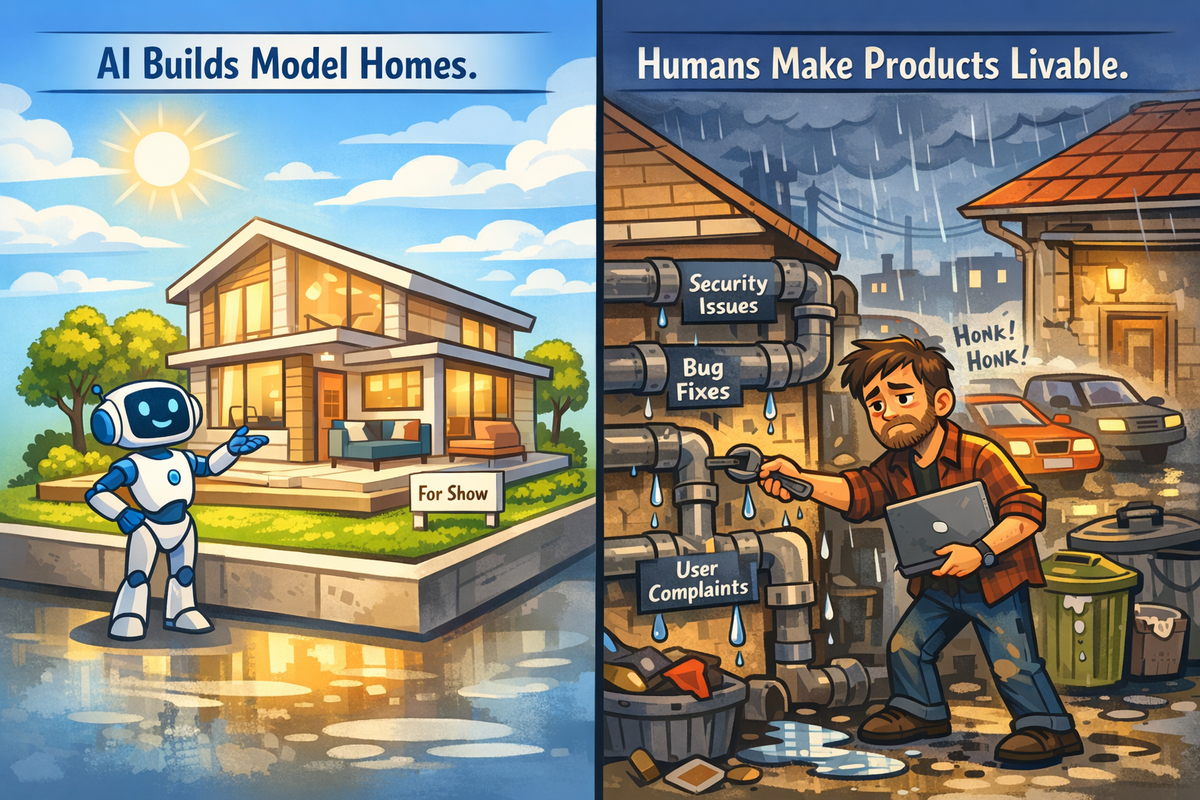
AI Builds Model Homes. Humans Make Products Livable.
These days, building software feels almost effortless.
You describe a feature.
AI generates UI, APIs, and workflows.
In hours, you have something that looks like a product.
It’s impressive.
But every time I see this, I think of model homes.
Model homes look perfect.
Great lighting.
Clean layouts.
Beautiful furniture.
You can walk through them.
You can imagine living there.
But you don’t learn the important things.
Morning traffic.
Nighttime noise.
Drainage smells after rain.
Whether the electrical system handles real usage.
Whether the doors actually lock.
And most importantly:
you don’t know if it’s safe.
You only discover those things after people move in.
AI-generated software works the same way.
AI is excellent at building structures.
It creates screens.
It connects endpoints.
It assembles features.
But AI doesn’t decide where that software lives.
It doesn’t understand production environments.
It doesn’t anticipate real user behavior.
It doesn’t feel operational pain.
It doesn’t recognize security risks unless explicitly told.
It doesn’t know why a system evolved the way it did.
That knowledge comes from outages.
From customer complaints.
From failed releases.
From hard tradeoffs made under pressure.
That history becomes architecture.
Which is why many AI-built products feel impressive at first, and fragile later.
They have buildings.
But they don’t have neighborhoods.
They haven’t lived in production.
Common issues show up quickly:
Missing edge cases.
Weak permission models.
Sensitive data exposed by default.
Systems that break under small changes.
Security treated as an afterthought.
It’s like a house with beautiful walls, but unfinished plumbing and unlocked doors.
A model home, not a real residence.
Here’s the core difference.
AI can build the building.
Humans place it into real life.
Humans adapt it to messy environments.
Humans account for risk.
Humans decide how it survives traffic, noise, users, attackers, and change.
AI creates structure.
People create context.
AI produces code.
People carry responsibility.
That’s why developers aren’t being replaced.
Their role is changing.
The job is no longer just writing code faster.
It’s understanding reality better.
The future belongs to those who can take generated structures
and make them safe, resilient, and usable in the real world.
AI can raise walls.
But only humans can make a place livable.
Code can be generated.
Context cannot.
And products are ultimately built on context.