
Elon Musk Says Coding May Die , Here’s What Actually Changes
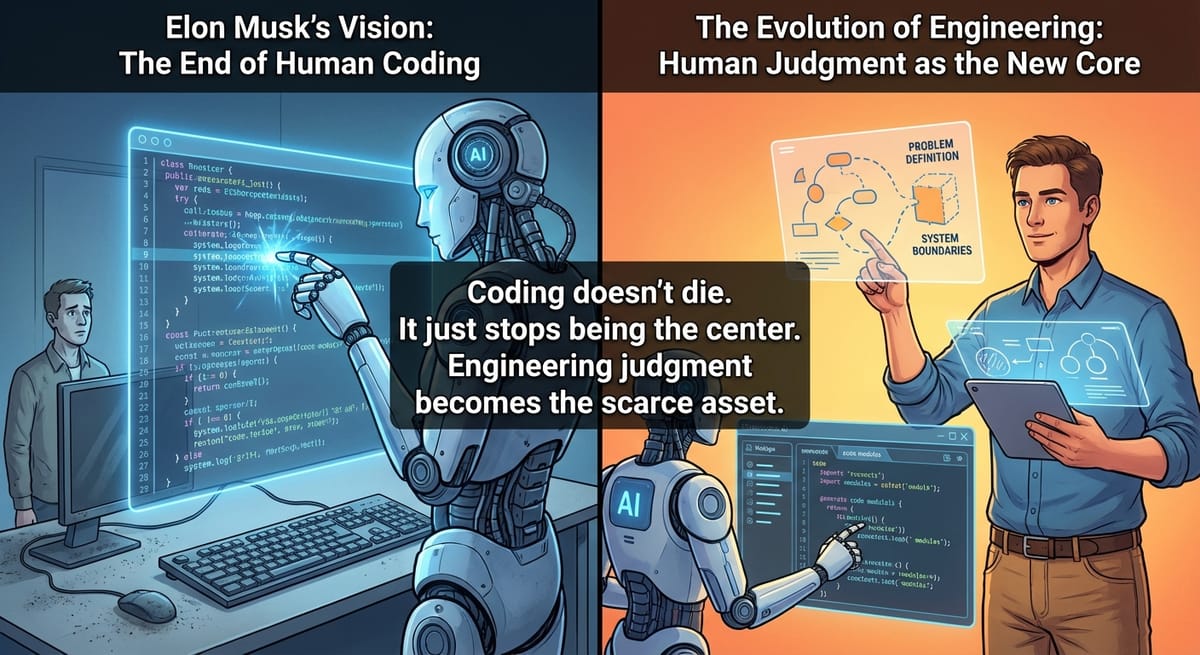
Not the end of implementation, but a shift in what matters
When Elon Musk suggests that coding may effectively “die” this year, he’s pointing at something real.
If AI can generate machine code directly — skipping programming languages altogether — then yes, the friction of implementation drops dramatically. The distance between idea and execution compresses.
That’s not science fiction.
That’s the direction abstraction has always moved.
But collapse? I don’t see it that way.
We’ve seen this abstraction cycle before
Technology consistently climbs layers.
Assembly gave way to higher-level languages.
Frameworks reduced boilerplate.
ORMs abstracted databases into objects.
When ORMs became widespread, many engineers assumed SQL would fade away.
Developers could “just work with objects.”
Technically, that shift happened.
Practically, SQL never disappeared.
When performance degraded, we inspected queries.
When data looked wrong, we queried the database directly.
When systems misbehaved, we dropped below the abstraction.
The abstraction layer expanded.
Observability came back.
It always does.
AI-generated systems will follow the same pattern
If AI begins generating machine code directly, we’re simply adding another layer.
But one question remains constant:
Why does the system behave the way it does?
Before trusting output, engineers build visibility.
We created logging.
We built debuggers.
We built profilers.
We built distributed tracing.
If AI writes the system, we’ll build tooling to inspect the AI’s output.
Abstraction shifts upward.
The need to understand shifts with it.
Implementation becomes cheaper. Accountability becomes heavier.
AI will accelerate execution.
It will also accelerate poorly framed intent.
If the problem definition is flawed, the system scales that flaw instantly.
At that point, the differentiator isn’t who wrote the code.
It’s who defined the problem.
Who understood the constraints.
Who modeled the failure cases.
This is less about developer extinction
and more about responsibility consolidation.
Execution automates.
Context ownership intensifies.
Coding doesn’t die. It loses centrality.
I don’t believe coding disappears.
But I do believe it stops being the center of gravity.
Typing speed won’t matter.
Language fluency won’t differentiate.
Structural clarity will.
Leverage moves upstream:
- From implementation velocity
- To problem framing
- From isolated optimization
- To system-level reasoning
Every time abstraction rises, engineers create a way to look beneath it.
There’s no reason to think this time is different.
Elon Musk may be right about one thing:
the mechanics of coding are changing fast.
But engineering judgment?
That’s becoming more valuable, not less.