
When AI Ships Too Fast: The Real Debt Isn’t Only Technical
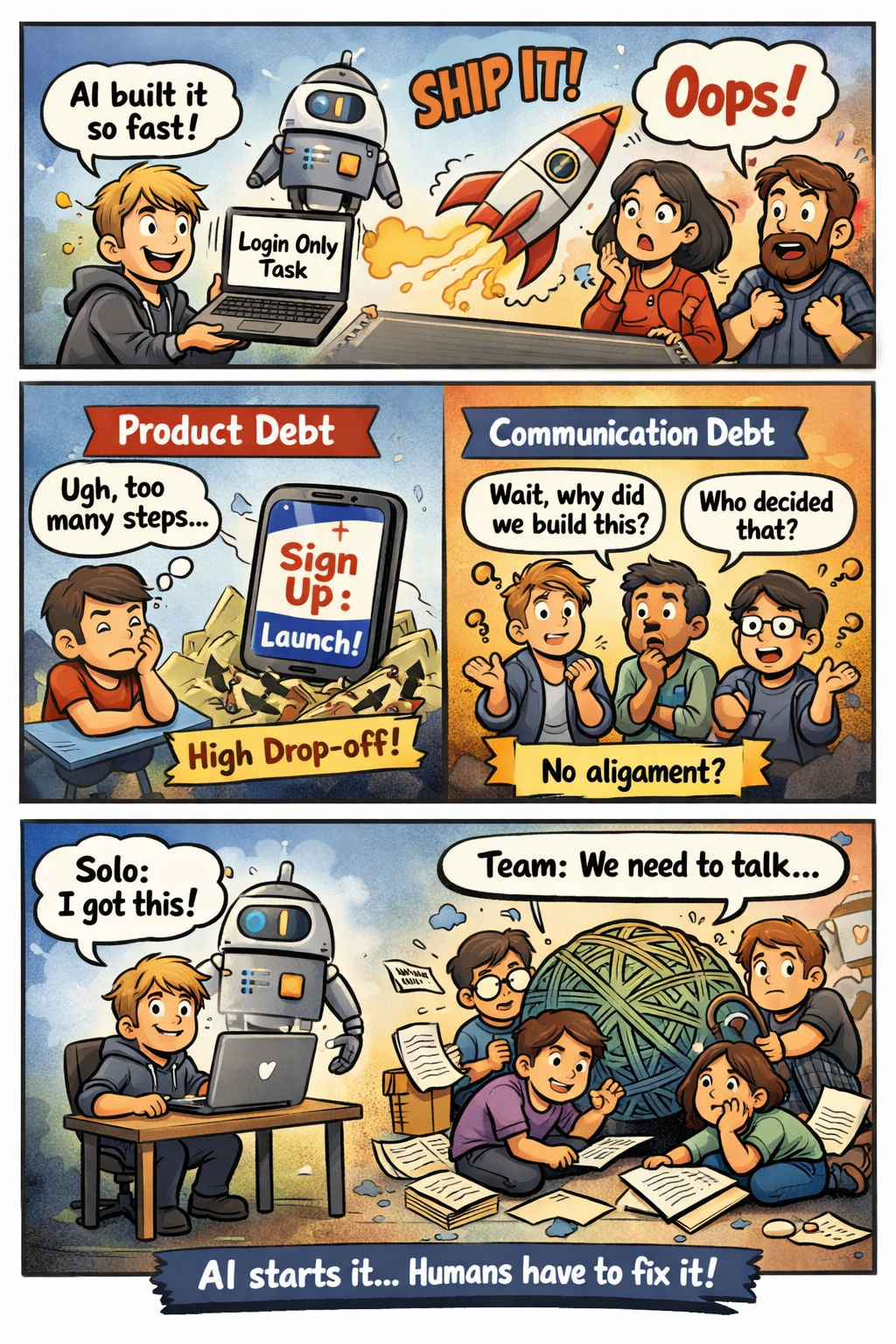
AI has made shipping feel absurdly easy.
In the Bay Area, it’s almost normal now to see a solo builder go from “idea” to “working MVP” in a weekend. If you’re a one-person team, AI can genuinely feel like having a full stack of teammates: PM, designer, engineer, and QA rolled into one.
So yeah, the question pops up:
Do we still need people?
Maybe not for the first version.
But once you’re building with a team, AI changes the failure mode in a really specific way:
It doesn’t just create technical debt.
It creates product debt and communication debt.
And that’s harder to pay back.
The “Login Only” Task That Turned Into a Full Sign-Up Flow
Here’s a real example.
We had a straightforward task:
“Implement login.”
That’s it. Not onboarding. Not registration. Just login.
A junior dev leaned heavily on AI, got the feature done quickly, and shipped it. When we reviewed the release, we realized they had also added a full Sign Up flow.
And the dev was proud:
- “AI already generated it.”
- “It was easy to add.”
- “More features is better, right?”
From a pure implementation standpoint, the work was solid.
From a product standpoint, it was a mess.
We Didn’t Skip Sign Up Because We Forgot
We intentionally avoided registration.
Not due to technical complexity, but because of product strategy.
We knew our users would often come from mobile, and many third-party auth flows were still optimized for desktop. Introducing a sign-up step in that path would increase friction and drop-off.
So the plan was:
- start with login
- keep entry friction as close to zero as possible
- push registration to the desktop web path where it’s smoother
This was a deliberate decision that came from understanding user behavior, not from engineering constraints.
And it got undone because AI “helpfully” suggested the extra feature.
The Core Problem: AI Doesn’t Know Your Context
AI output looks like a correct answer.
Especially to junior engineers, it’s insanely convincing:
- The code compiles
- The UI works
- The happy path looks great
- The feature feels complete
But product development isn’t about producing the “most complete feature set.”
It’s about shipping the right thing, in the right order, for the right reasons.
AI has zero awareness of:
- what you’re optimizing for this sprint
- what your funnel metrics look like
- what your support capacity is
- what operational risks you’re trying to avoid
- what decisions the team already aligned on
It’s not malicious.
It’s just context-blind.
AI Doesn’t Just Create Tech Debt. It Creates Product Debt.
We all know tech debt:
- messy architecture
- missing tests
- rushed hacks
- bad abstractions
But what AI-enabled teams accumulate faster is product debt:
When the product drifts away from shared intent.
Product debt looks like:
- features that technically work but break the intended user journey
- onboarding flows that increase churn
- “improvements” that conflict with positioning
- operational complexity introduced too early
- decisions reversed without alignment
And unlike tech debt, product debt is expensive because it hits the market.
Users don’t just experience your roadmap.
They experience what you shipped.
And they’ll assume it’s intentional.
The Sneakier One: Communication Debt
The most dangerous debt AI creates in teams is communication debt.
Here’s what happens when AI makes building “too easy”:
Engineers stop asking questions because implementation is instant.
You go from:
- “Why are we doing it this way?”
- “What’s the tradeoff?”
- “What problem are we actually solving?”
to:
- “It’s easy, I’ll just add it.”
- “We can change it later.”
- “AI already did it.”
This is how “AI silos” form.
Everyone can move fast individually, but the team drifts because shared decision-making disappears.
Communication debt looks like:
- context not being shared
- decisions not being documented
- product intent being replaced by “whatever AI suggested”
- rework exploding later because alignment was skipped
At some point the team realizes:
“We’re not even sure what we’re building anymore.”
AI Can Start the Product, But It Can’t Operate It
If you’re solo, AI can absolutely be leverage.
But the moment you’re operating a real product, you’re in a different world:
- customer support
- analytics and funnel tuning
- bug triage
- policy changes
- onboarding improvements
- marketing and messaging consistency
- cross-team coordination
- prioritization tradeoffs
That world requires people.
Not because AI can’t write code.
But because operations is collaboration.
AI can generate output.
Only humans can maintain alignment.
The Real Edge in an AI World
As AI increases code velocity, the differentiator shifts.
It won’t be about who can implement faster.
It’ll be about who can:
- align faster
- make better decisions
- preserve context
- communicate intent clearly
- build systems that teams can operate together
AI can help you ship.
But the teams that win will be the ones that don’t let AI quietly rewrite their product strategy without a conversation.